What It Costs to Fix Frozen Pipes in 2026
How much does it cost to fix frozen pipes? Either one of the cheapest plumbing calls you'll ever make or one of the most expensive, and the difference is whether the ice has already cracked the line. Professional thawing of an intact line typically runs $100-$200. Once a frozen pipe bursts, you're buying a repair ($200-$3,000 for most jobs) and possibly water-damage cleanup on top. Any honest estimate therefore opens with a counter-question: is water leaking anywhere yet?
This guide prices both paths, using 2025 national cost data compiled by Angi and HomeAdvisor and insurance figures from the Insurance Information Institute, so you can budget before the first phone call.
How much does it cost to fix frozen pipes? Both scenarios priced
| Scenario | Typical cost | What's included |
|---|---|---|
| DIY thawing (line intact, accessible) | $0 plus a little electricity | Hair dryer, heating pad, or space heater; safety rules below |
| Professional thawing | $100-$200; up to $500 | Flat fee is common; the high end is deep or inaccessible pipe |
| Burst pipe repair | $200-$3,000, average about $500 | Cutting out the split section and joining new pipe |
| Replacement, accessible runs | $150-$250 per linear foot | Full run replacement, labor and materials |
| Underground line or repair plus water damage | Up to $5,000 | Excavation or drying and restoration on top of plumbing |
| Average insurance claim, water damage and freezing | $13,954 | III claim severity, 2018-2022; what waiting can cost |
Not sure which scenario you're in? A licensed local plumber can usually tell from a pressure check what a frozen line has done inside your walls. Call (800) 555-0173 and NorthBriar connects you with licensed, insured pros in your area, free call, no obligation.
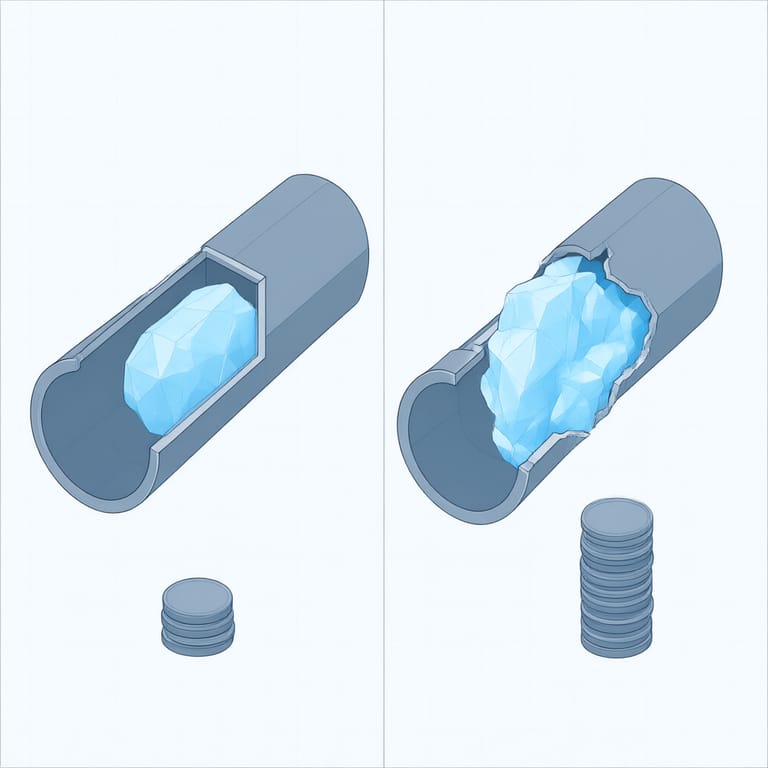
Scenario one: frozen but intact, the $100-$200 call
When nothing is leaking and a fixture simply won't flow, plumbers treat thawing as a quick service call, often at a flat fee of around $100. What pushes it toward $200 and beyond:
- Finding the ice. A frozen kitchen line under the sink takes minutes to locate. A freeze somewhere along a crawl-space run takes longer, and time is money.
- Reaching it. Pipes freeze precisely where houses are hardest to work in: attics, rim joists, crawl spaces, exterior walls. Deep or boxed-in runs are how a thawing call reaches the $500 high end.
- Equipment. Pros use pipe-thawing machines and controlled heat for lines you can't safely warm with household tools.
There's also a physics clock running. Field research by the Building Research Council at the University of Illinois found that uninsulated lines in unheated spaces start freezing when outdoor temperatures hit 20°F or below; 2025 Angi data puts the typical time for an unprotected line to freeze solid in that cold at 6-8 hours. The longer a line stays frozen and pressure builds behind the ice, the higher the odds you leave the cheap scenario for the expensive one.
Your first moves matter more than speed-dialing, though. Before anyone arrives, follow the steps in what to do when pipes freeze to relieve pressure and cut the risk of a burst while you wait.
Scenario two: frozen and burst, now it's a repair job
Ice expands with enormous force, and when it splits a line you won't necessarily know until the thaw, because the ice itself often plugs the crack. The moment flow returns, so does the evidence, usually as a leak you can finally hear or see. So how much does it cost to fix frozen pipes once one has already split? Burst-pipe economics take over:
- Most repairs land between $200 and $3,000, with the national average around $500.
- About 80% of the bill is labor: plumbers charge $45-$200 per hour or flat rates of $100-$1,250, and after-hours calls commonly add a $50-$300 trip fee.
- If the run needs replacing rather than patching, accessible work costs $150-$250 per linear foot.
- Underground lines or jobs with water-damage restoration attached can reach $5,000.
One freeze-specific warning: a hard freeze can split a line in more than one place, so ask the plumber to pressure-test the whole run before closing walls. Paying for one repair twice is the classic post-freeze mistake. For the full pricing breakdown (access factors, in-wall and under-slab scenarios, insurance math), see our burst pipe repair cost guide.
Need a licensed plumber right now?
Call (800) 555-0173Free call, connects to a licensed local plumberLicensed plumbing partners in your area- Licensed and insured partner network
- 24/7 call routing
- Free call, no obligation
- You approve the price with the plumber directly
DIY thawing: free, if you respect the safety rules
If you can see and reach the frozen section, thawing it yourself costs essentially nothing. The American Red Cross protocol, which we treat as the baseline for every thawing job:
- Keep the affected faucet open; moving water helps melt ice and relieves pressure.
- Warm the section gradually: wrap it in an electric heating pad, work a hair dryer along it, set a portable space heater nearby but clear of anything that can catch, or lay on towels soaked in hot water.
- Stay with it until the tap runs at full pressure.
- Open flame is off the table in every form: blowtorches, propane and kerosene heaters, charcoal stoves, all of it. Flame starts house fires and can boil water inside the pipe, bursting it explosively.
The full step-by-step, including how to work along a frozen run, is in our guide on how to thaw frozen pipes.
Stop and call a professional when you can't locate the frozen section, can't reach it, can't thaw it, or when you see any water where it shouldn't be. That's the Red Cross threshold too, and it exists because amateur heat on hidden runs is how intact lines become burst ones. A frozen pipes plumber with a thawing machine finishes safely what a hair dryer can't. NorthBriar can connect you with one at (800) 555-0173.
The cost of waiting: insurance math
The Insurance Information Institute puts the average homeowners claim for water damage and freezing at $13,954 (2018-2022), roughly 70 to 140 times the price of a professional thawing call. About 1 in 60 insured homes files one of these claims each year, and in 2022 this category made up 27.6% of all homeowners insurance losses.
That's the entire economic argument in one paragraph: a $100-$200 thawing call, or even a $500 repair, is cheap insurance against a five-figure claim, a deductible, and years of higher premiums. This is the rare plumbing problem where acting fast has a measurable, published return.
What determines your final bill
Five things set the cost of repairing frozen pipes:
- Intact vs. burst. The $200 question vs. the $2,000 one; everything else is secondary.
- Access. Visible basement pipe sits at the range's bottom; crawl spaces, attics, and finished walls climb toward the top.
- Timing. Freeze events cluster during cold snaps when every plumber's phone rings at once; after-hours and surge periods bring trip fees and premium rates.
- Extent. One frozen branch line vs. a whole-house freeze after a furnace failure are different jobs entirely.
- Material. PEX tolerates freezing better than copper, but nothing is freeze-proof; brittle old galvanized lines often turn a thaw into a replacement.
Frozen pipe cost FAQ
How much does it cost to thaw frozen pipes professionally?
Typically $100-$200 as a flat-fee service call, rising to around $500 when the frozen section is deep, hidden, or hard to reach, per 2025 Angi data.
What does a plumber charge for frozen pipe work overall?
Plumbers charge $45-$200 per hour or flat rates from $100 to $1,250 depending on the job. Thawing sits at the bottom of that scale; the cost to repair frozen pipes after a split sits higher, plus a possible $50-$300 travel fee for emergency calls.
What does replacing frozen water pipes run?
Accessible replacement runs $150-$250 per linear foot, labor included. Replacing a chronically freezing run, ideally rerouted through heated space, is often cheaper over five years than repeated thawing calls.
What about frozen hot tub pipes?
Freeze damage in hot tub plumbing is priced case by case: it depends on how many lines and fittings cracked, and there's no reliable national figure. Winterizing the tub before hard freezes is the only cheap option; ask a local pro for an inspection quote if it's already frozen.
Will insurance pay for frozen pipe repairs?
Policies generally treat sudden freeze-related water damage as coverable, but may exclude it if the home sat unheated or neglected, and the pipe repair itself isn't always included. With average claims near $14,000 (III), it's worth reading your policy before winter, not after. Confirm specifics with your insurer.
Need a licensed plumber right now?
Call (800) 555-0173Free call, connects to a licensed local plumberLicensed plumbing partners in your area- Licensed and insured partner network
- 24/7 call routing
- Free call, no obligation
- You approve the price with the plumber directly