Pipe already burst, or water where it shouldn't be? Don't read, act. Close the main shutoff valve, keep away from any standing water that's touching outlets or appliances, and call (800) 555-0173. You'll be routed to a licensed plumber in your area; lines answer around the clock during freeze season. Our burst pipe guide walks through the shutoff if you've never done it.
Why frozen pipes deserve an hour of your attention
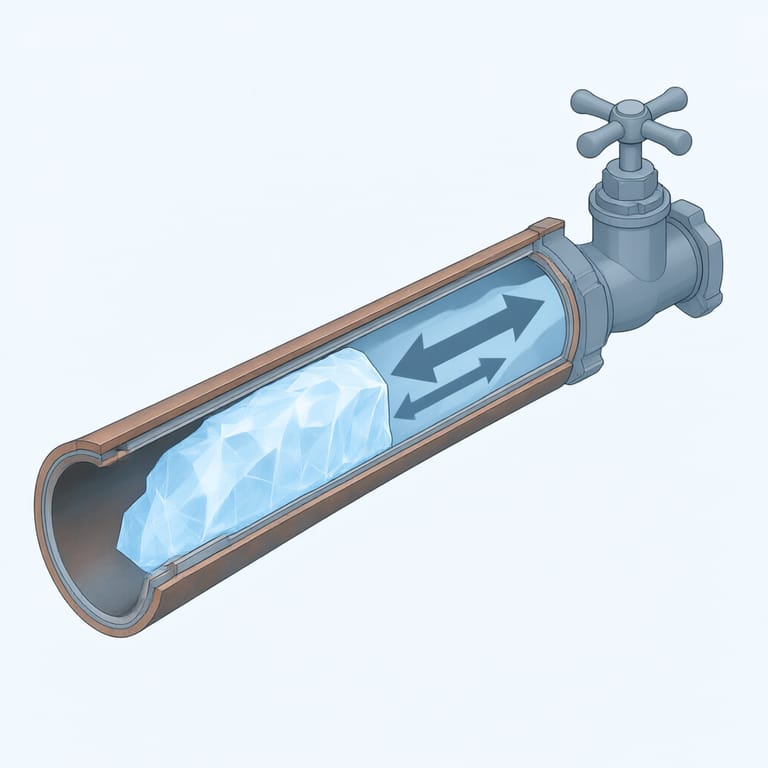
Frozen pipes are not the kind of problem that fixes itself. When ice forms inside a water line, pressure builds between the blockage and the closed faucet downstream, and if the pipe splits, the water damage starts the moment it thaws. The Insurance Information Institute puts the average homeowners claim for water damage and freezing at $13,954 (2018-2022 claims data), and about one in sixty insured homes files one of these claims every year.
Compare that with the other end of the problem: professional thawing of a frozen line that hasn't burst typically runs $100-$200 (Angi, 2025), and most prevention steps cost less than a dinner out. That spread, a four-figure claim versus a two-figure fix, is why NorthBriar exists. Knowing what to do about frozen pipes in the first hour usually decides which side of it you land on.
When do pipes actually freeze?
Not at 32°F, as it turns out. Water in pipes supercools before ice forms, so the practical danger starts lower: meteorologists' rule of thumb puts exposed, unprotected runs at risk around 28°F held for roughly four to six hours or more. For lines in unheated parts of the house (attics, crawl spaces, garages), Building Research Council field tests at the University of Illinois found freezing begins once outside temperatures drop to 20°F; unprotected lines typically freeze within 6-8 hours at that mark (Angi, 2025). When the forecast shows a night in the low 20s, that's your signal to act, not to wait.
Is a frozen pipe an emergency?
It depends on one question: has anything burst yet?
- Dry faucet, no visible leak? There's still time to act, though not an unlimited amount. Pipes frozen solid overnight keep building pressure while the cold holds. Start with what to do when pipes are frozen and check the signs the freeze is real before assuming the worst.
- Should you open the faucet? Yes, keep the affected faucet open. American Red Cross guidance on thawing says to leave the faucet open the whole time you apply heat: moving water erodes the ice plug and gives the trapped pressure somewhere to go.
- Should you shut off the water? If you see any leak, bulge, or crack, or you're leaving the house before the pipe is thawed, shut off the main. A thawing split can go from damp spot to flooded floor in minutes.
- Already burst? That's an emergency. Water off, electricity off in the affected area, then call (800) 555-0173.
If you can reach the frozen section, thawing it yourself usually takes nothing more exotic than a hair dryer and patience. If the ice is behind a wall, underground, or in a ceiling, that's when a pro with the right equipment earns the fee.
Need a licensed plumber right now?
Call (800) 555-0173Free call, connects to a licensed local plumberLicensed plumbing partners in your area- Licensed and insured partner network
- 24/7 call routing
- Free call, no obligation
- You approve the price with the plumber directly
Who's behind NorthBriar
NorthBriar is an independent publisher, not a plumbing company. We don't have trucks, and we won't pretend to. What we do is research: our guides are built from published safety protocols (American Red Cross, Building Research Council), insurance industry claims data, and cost figures from national repair-cost databases. Every number in our pages is sourced, and our editorial policy explains exactly how each page is researched, drafted with AI assistance, and reviewed before it's published. The economics of the phone number (who pays us, and for what) are laid out on how we make money.
Our coverage is written for the northern tier of the U.S., the freeze belt, where design frost depths run deep and a January cold snap is a certainty rather than a surprise. If you're further south reading this during a rare hard freeze, the physics and the advice hold; only the urgency changes.
Fix the cause, not just the symptom
Once the immediate freeze is handled, the pipe that froze this week will freeze again in the next cold snap unless something changes. The winterization hub covers the fixes in order of bang-for-buck: pipe insulation on exposed runs, heat cable where insulation isn't enough, sealing the drafts that pour cold air onto plumbing, and the faucet-dripping technique for nights that dip into the danger zone.
Need a licensed plumber right now?
Call (800) 555-0173. The call is free and answered 24/7 during freeze season, and one number covers frozen pipes, burst lines, and everything between. NorthBriar connects you with licensed, insured local plumbing partners; you approve any work and price directly with the plumber.
Need a licensed plumber right now?
Call (800) 555-0173Free call, connects to a licensed local plumberLicensed plumbing partners in your area- Licensed and insured partner network
- 24/7 call routing
- Free call, no obligation
- You approve the price with the plumber directly