Once the main is closed and the floor is toweled off, the question changes from make it stop to fix it right. This guide covers what a proper burst pipe repair involves, what it should cost, and how to tell a clean fix from a patch job, so when a plumber walks you through a quote, you know exactly what you're approving. (Still mid-emergency with water moving? Start with the burst pipe plumber page or call (800) 555-0173 now.)
How a plumber actually fixes a ruptured line
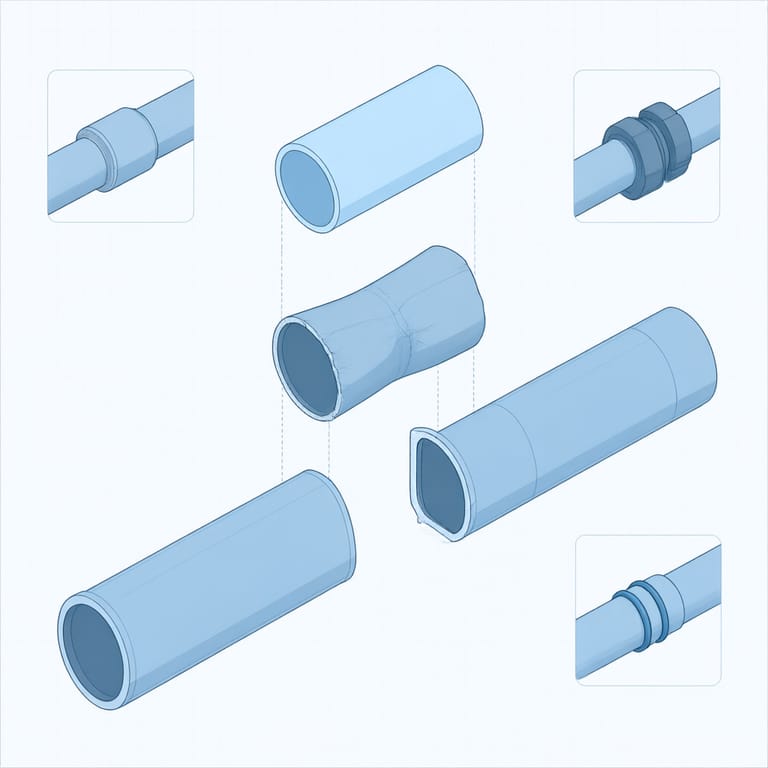
To repair a burst pipe, a plumber runs a cut-and-replace operation, and the craft is in the finding and the sealing:
- Locating the break. Obvious splits announce themselves. Hidden ones get tracked with moisture meters, thermal cameras, and educated listening before anyone opens drywall. Good plumbers cut small, square, patchable openings, not exploratory craters.
- Isolating and draining. Water off at the main or a branch valve, faucets opened low and high so the section being repaired is empty and dry. Solder won't take, and press tools won't seal, on a wet, pressurized line.
- Cutting out the damage. The split section comes out with a few inches of margin, because frozen or corroded pipe is often weakened beyond the visible failure.
- Splicing in new pipe. On copper, that's a soldered ("sweat") joint or a press fitting crimped with a powered tool; press work shines where open flame near framing is a bad idea. On PEX, it's a new section with crimp or expansion fittings. Push-to-connect couplings have their place on accessible, exposed runs, though many pros treat them as temporary in concealed walls.
- Pressure testing. The system gets re-pressurized and the joint watched under full line pressure before anything gets closed up. A repair that skips this step isn't finished.
The visit from your side of the wrench
- You describe the failure, and the dispatcher or plumber triages urgency.
- On site: locate, diagnose, and a written quote before work starts, covering scope, materials, and whether wall or ceiling access is included.
- You approve. With NorthBriar, you're approving work and price directly with the licensed contractor; we're the publisher who connected you, not a middleman on the invoice.
- The repair proceeds as above: isolate, cut, splice, test.
- Walkthrough: you see the new section under pressure, learn what failed and why, and get documentation. Keep it with the photos for any insurance conversation.
An accessible splice is commonly a single-visit job; hidden breaks that need access cuts, or soaked areas that need drying first, stretch the timeline. Be suspicious of anyone quoting a firm schedule before they've seen the pipe.
What burst pipe repair costs
Numbers below are from Angi and HomeAdvisor 2025 pricing data; your quote will move with access, material, and timing.
| Scenario | Typical price |
|---|---|
| National average, all burst-pipe jobs | ~$500 |
| Most repairs fall between | $200-$3,000 |
| Accessible runs, per linear foot (labor + materials) | $150-$250 |
| Underground lines or repairs with water-damage cleanup | up to $5,000 |
| Labor rates | $45-$200/hr, or flat $100-$1,250; possible $50-$300 travel fee |
Burst pipe repairs are mostly labor, roughly 80 percent of a typical bill, which explains the spread: a reachable basement run is quick work, while the same split inside a finished wall, or after hours during a cold snap, is not. Line-item detail, including how insurance usually splits pipe versus damage, is in the burst pipe repair cost guide.
Need a licensed plumber right now?
Call (800) 555-0173Free call, connects to a licensed local plumberLicensed plumbing partners in your area- Licensed and insured partner network
- 24/7 call routing
- Free call, no obligation
- You approve the price with the plumber directly
Why buried lines cost the most in the freeze belt
Water services up north are buried below the local frost line by code, and that line sits deep here: design frost depths reach 42-60 inches across the upper Midwest and up to 80 inches in northern Minnesota, per state frost-line compilations of FHWA data. A break in that pipe means excavation to that depth, in whatever your yard is made of, sometimes in January. That's the honest reason an underground repair can cost ten times a basement splice, and why quotes for yard leaks vary so much between properties.
Repair the section, or repipe the run?
A spot repair makes sense when the failure has one clear, external cause: a freeze split on an otherwise healthy line, a nail strike from a remodel, a single failed joint. Fix it, fix the cause, move on.
Start pricing a repipe when the pipe itself is the problem: a galvanized line shedding rust flakes, copper with repeated pinholes along the same run, or a second and third split appearing near past repairs. Paying for spot fixes on a failing run is renting time, not buying a solution. A straight plumber will tell you which side of the line you're on; ask them to show you the cut-out section, because corroded pipe walls speak for themselves.
Questions homeowners actually ask
Can I fix a burst pipe myself? On an exposed, drained line, a handy owner with a push-fit coupling can make a legitimate temporary fix. Inside walls or ceilings, on main lines, or anywhere a failed joint means another flood, that's licensed-pro territory, and some jurisdictions require it for concealed supply work.
Is a burst pipe an emergency? While water is moving, yes. Act first, read later. Once the line is isolated and drained, it becomes urgent-but-schedulable, which also means daytime rates.
How long does the fix take? Honest answer: it depends on access. A visible splice is a short visit; opening finished surfaces and drying wet cavities extends things. No one can promise hours without seeing the pipe.
Will insurance pay for it? Carriers commonly cover the sudden water damage more readily than the pipe itself, and gradual leaks less readily than sudden ruptures. Photograph everything, keep the repair invoice, and confirm coverage with your carrier, because policies differ too much for anyone to promise from a web page.
What if the burst is in an apartment or condo? Responsibility splits between unit owner, neighbors, and building management in ways worth getting right before the finger-pointing starts; see apartment pipe burst.
It keeps happening every winter. Why? Recurring splits are a symptom, not bad luck. Work through what causes pipes to burst to find the underlying problem worth fixing once.
Three hesitations, answered straight
- "The quote feels steep." Compare a burst pipe fix to the alternative, not to zero: the Insurance Information Institute puts the average water-damage-and-freezing claim at $13,954. Most repairs cost a small fraction of that.
- "I don't want my walls torn open." A locator-equipped pro cuts one patchable opening. Water you leave running makes the bigger hole, and picks its own location.
- "Maybe the tape is holding fine." Supply lines carry pressure around the clock. Tape and clamps are how a Tuesday problem becomes a 3 a.m. one.
Ready for a real fix? Call (800) 555-0173: free call, licensed and insured local plumbers, and you approve every dollar directly with the pro. More burst-pipe guides live at the hub.