How to Unfreeze Frozen Pipes Without Bursting Them
A faucet that sputters, trickles, and quits on a subzero morning almost always means ice somewhere in the line. The good news: once you know how to unfreeze frozen pipes correctly, most lines clear in a few hours with tools you already own, and the right sequence greatly lowers the chance of a split. The method below follows the American Red Cross thawing protocol, with the practical details the short version leaves out.
If the freeze is inside a finished wall, under a slab, or you already see water where it shouldn't be, skip the DIY and talk to a frozen-pipe plumber, or call (800) 555-0173 and we'll connect you with a licensed local pro.
Safety before you touch anything
- Never use open flame. No blowtorch, no kerosene or propane heater, no charcoal; the American Red Cross bans all of them for thawing. Flame damages the line, ignites framing, and can flash water to steam inside a sealed line.
- Keep electricity away from standing water. If the floor near the line is wet, don't run a hair dryer or space heater there until it's dry.
- Find your main water shutoff first. It's usually where the supply enters the house: basement, crawl space, garage, or utility closet on the street-facing wall. If the line turns out to be split, you'll want to close that valve in seconds, not minutes.
- If a pipe bursts while you work: shut off the main, flip the breaker for any circuits near the water, open the lowest faucet in the house to drain pressure, then get a pro on the phone.
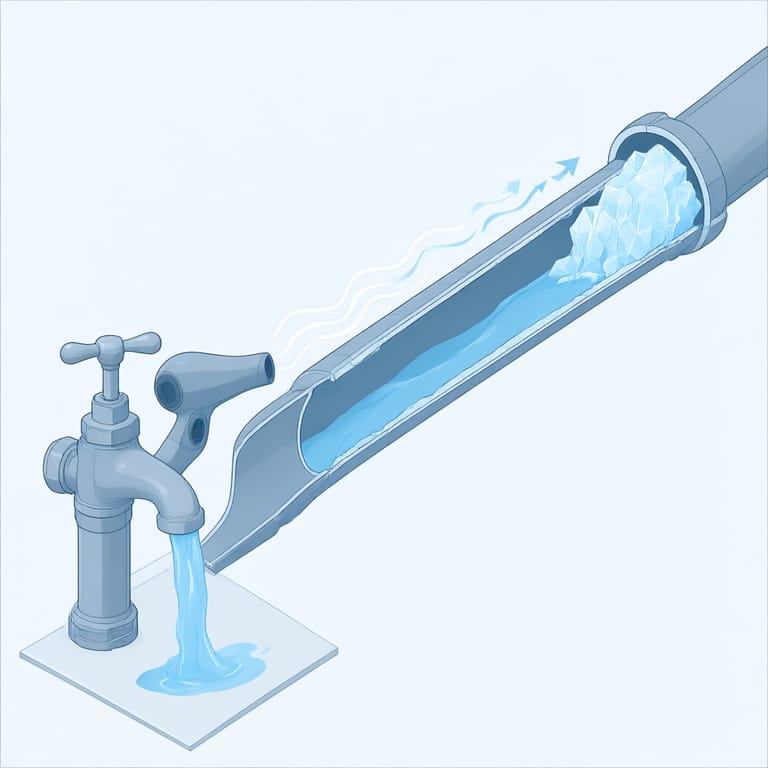
How to unfreeze frozen pipes: what you'll need
Nothing exotic: a hair dryer, an electric heating pad or heat tape, bath towels and a bucket of hot water, a portable electric space heater for larger areas, and a flashlight. Skip heat guns; they run hot enough to melt solder and scorch PEX.
Step 1: Crack the tap and keep it open
Go to the fixture the frozen line serves and open both handles, hot and cold. This does two jobs: it relieves the pressure trapped between the ice and the tap (the pressure, not the ice itself, is what bursts pipes), and once melting starts, moving water eats through the remaining ice far faster than outside heat alone. The Red Cross protocol keeps the faucet open for the entire thaw.
Step 2: Hunt down the ice plug
Working from the dead fixture back toward the meter, run your hand along every stretch you can reach; the plugged length feels sharply colder than the rest of the run. Frost, condensation, or a slight bulge on the line marks the spot. Ice usually forms where pipes meet cold air: exterior walls, crawl spaces, attics, garages, and under sinks. If nothing obvious turns up, our guide to finding where pipes are frozen walks through the process fixture by fixture.
Step 3: Apply gentle heat, starting at the faucet
Work from the open faucet toward the ice, not the other way around. Heating the middle of a blockage first traps meltwater and steam between two ice plugs, which is exactly the pressure spike you're trying to avoid.
Any of these, per the Red Cross list, will defrost frozen water pipes safely:
- Hair dryer. Sweep it back and forth along the pipe; don't park it in one spot.
- Electric heating pad. Wrap it around the line and let it work. Slow but steady, ideal for a single joint or valve.
- Hot towels. Soak in hot water, wrap the pipe, swap as they cool. Handy where there's no outlet.
- Portable space heater. Best for warming a whole cabinet, crawl space, or garage section; keep it well away from anything flammable. Placement and run-time details are in our space heater thawing guide.
Need a licensed plumber right now?
Call (800) 555-0173Free call, connects to a licensed local plumberLicensed plumbing partners in your area- Licensed and insured partner network
- 24/7 call routing
- Free call, no obligation
- You approve the price with the plumber directly
Step 4: Continue until full pressure returns
A trickle means you're winning, because moving water accelerates the melt. Keep the heat on until the faucet runs at normal, full pressure; that's the endpoint the Red Cross specifies. Then open other faucets to confirm nothing else is blocked, and check the thawed run for drips or spray. A line that froze hard may have already split and simply couldn't leak until the ice let go.
How do you thaw frozen pipes fastest? Match the tool to the spot
| Method | Best for | Watch out for |
|---|---|---|
| Hair dryer | Exposed pipe you can reach and see | Wet floors; keep it moving |
| Heating pad | One stubborn joint, valve, or short run | Slow on long sections |
| Hot towels | Spots with no power outlet nearby | Cools fast; re-soak often |
| Space heater | Cabinets, crawl spaces, garages | Clearance from flammables; never unattended |
| Heat tape | Runs that freeze every winter | Buy UL-listed; follow the wrap spacing in the manual |
Heat tape doubles as prevention: once the line is thawed, a permanent wrap can end the annual ritual. See our heat tape guide for choosing and installing it.
Does pipe material change the approach?
Copper conducts heat well, so a hair dryer or heating pad works quickly. But copper also splits readily when ice expands, so inspect it closely after thawing. Galvanized steel takes longer to warm through; be patient rather than hotter. PEX tolerates some ice expansion but hates high heat: keep any heat source on low and moving, and never above roughly the temperature your hand can tolerate on the pipe. Frozen PEX has its own quirks, covered in our frozen PEX pipes guide.
For pipes under the house or outside (hose bibs, crawl-space runs, well lines), the same faucet-first, gentle-heat sequence applies, but ventilation-safe electric heat is the only option in tight spaces.
Is it safe to just wait it out?
Sometimes, if the cold snap is ending and the pipe hasn't burst. But an unattended thaw can turn a hidden split into an unattended flood. Field research by the Building Research Council at the University of Illinois found uninsulated attic pipes begin freezing once outside temperatures hit 20°F, and until the weather climbs well above freezing for a sustained stretch, that ice isn't going anywhere. The honest timeline math is in do frozen pipes thaw on their own.
When to stop and call a pro
Knowing how to thaw frozen pipes matters less than knowing when not to. Set the tools down and hand the job to a licensed plumber when:
- The ice sits somewhere you can't get at: behind drywall, under a slab, in a ceiling, or nowhere you can find.
- The line thaws but pressure never fully returns; a partial blockage or hidden split is likely.
- You see a bulge, crack, frost re-forming, or hear hissing anywhere on the run.
- The same pipe freezes repeatedly every cold snap. That's an insulation or routing problem, not bad luck.
Professional thawing typically runs $100-$200 when nothing has burst, up to about $500 for deep or hard-to-reach lines, per Angi's 2025-2026 cost data. Compare that to the average insurance claim for water damage and freezing, $13,954 per the Insurance Information Institute (2018-2022 claims), and the service call is cheap insurance. Call (800) 555-0173 and NorthBriar will connect you with a licensed, insured plumbing partner in your area, 24/7 during freeze season.