Frozen Pipes: What to Do in the First Hour
It's the coldest morning of the year, and the kitchen tap answers with a hiss of air and a dribble. Frozen plumbing pipes are almost always the culprit: somewhere between the meter and that faucet, an ice plug has sealed the line. What you do in the next hour decides whether this stays a nuisance or turns into a soaked ceiling.
Here's the whole play, in order.
Step 1: Make Sure It's Actually a Freeze
Before heating anything, confirm the diagnosis, because a closed valve or a utility outage looks identical from the faucet:
- One fixture dead, others fine? Classic branch-line freeze, usually in a run along an exterior wall or through unheated space.
- The whole house dry? Suspect the service entry or meter area; see frozen pipes and no water for that specific triage.
- Has it been cold enough, long enough? Meteorologists' rule of thumb, as published by WAFB's weather team: exposed pipes don't freeze at 32°F. Real risk starts around 28°F held for roughly four to six hours. A 40°F night means the problem is probably not ice.
Still unsure? Run through the signs your pipes are frozen first.
Step 2: The First-Hour Checklist
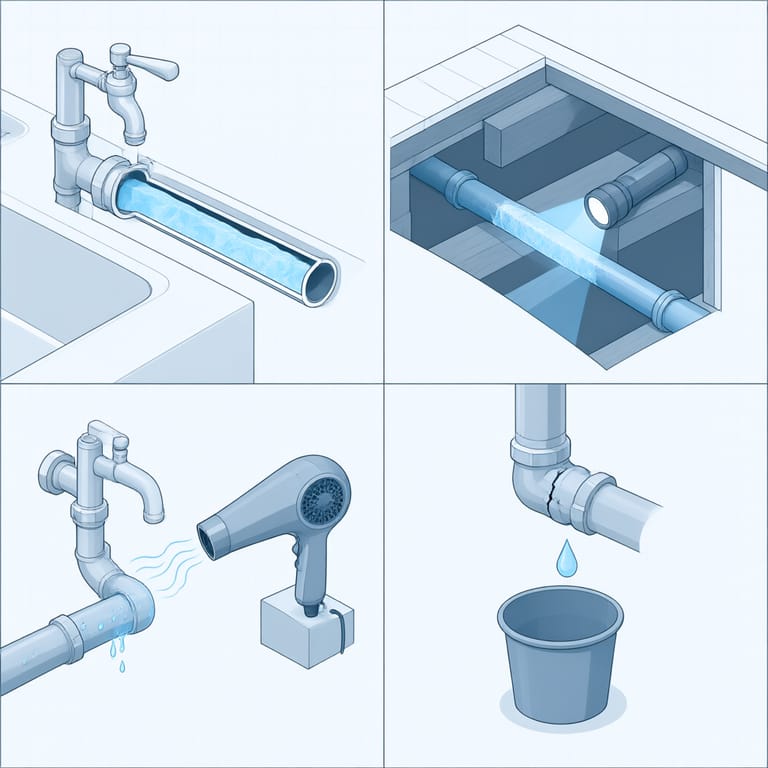
- Crack the affected faucet and keep it that way. The American Red Cross puts this first in its frozen-pipe guidance for a reason: flowing meltwater helps melt more ice, and an open tap relieves the pressure that causes bursts.
- Hunt down the frozen stretch. Follow the dead fixture's line back through the coldest spaces, feeling for a section noticeably icier than the rest and watching for frost or condensation on the outside.
- Warm it gently, from the faucet side back toward the plug. A hair dryer, a heating pad wrapped on the pipe, or hot-water-soaked towels all qualify.
- Watch for leaks as it thaws. Ice can split a line silently; the flood starts when the ice stops sealing its own crack. Keep an eye (and an ear) on every section you warm.
- Learn your main shutoff's location before the moment you need it. If water appears where it shouldn't, close the main, then drain pressure away from the break through the lowest faucet in the house.
The Quickest Safe Ways to Unfreeze Pipes
The best way to unfreeze frozen water pipes is the least dramatic one: gentle heat, an open tap, and patience. You thaw the ice; if melting reveals a split, a pro can fix it the same day. Every method below follows that rule.
| Method | Best for | Keep in mind |
|---|---|---|
| Hair dryer | Accessible pipe, short frozen section | Slow but precise; keep it moving |
| Electric heating pad, wrapped | A single cold spot you've located | Steady heat; check it every few minutes |
| Portable space heater | Cabinets, crawl spaces, whole cold corners | Keep it well away from anything flammable |
| Hot-water-soaked towels | Pipes near a sink; PEX and plastic lines | Re-soak often; gentlest option |
What's never on the list, per the same Red Cross protocol: blowtorches, kerosene or propane heaters, charcoal stoves, or any open flame. A flame is how a thawing job becomes a house fire, and heat that intense can flash trapped water to steam and rupture the line. Full walkthrough with photos of where to aim: how to thaw frozen pipes.
Can You Pour Anything Down the Drain to Unfreeze Pipes?
For frozen plumbing pipes on the supply side (the pressurized lines that feed faucets), no. Anything poured into a drain goes down the drain system and never touches the supply side where the ice is.
The exception is a frozen drain trap (common in vacant homes): a pot of hot water poured slowly, with a handful of salt dissolved in it, can clear a frozen P-trap. Skip chemical de-icers and boiling-water shock treatments; both damage the line and its gaskets.
Need a licensed plumber right now?
Call (800) 555-0173Free call, connects to a licensed local plumberLicensed plumbing partners in your area- Licensed and insured partner network
- 24/7 call routing
- Free call, no obligation
- You approve the price with the plumber directly
How Long Before a Frozen Pipe Bursts?
Honest answer: there's no countdown clock, and frozen pipes don't always burst. The damage mechanism isn't ice crushing the pipe; it's pressure. As the plug grows, water trapped between the ice and your closed faucet gets squeezed until something gives, usually at a joint or a weak seam.
That's why the risk rises with time. A run that froze overnight and thaws by noon often survives. A line that stays frozen for days, with pressure climbing the whole time, is the one that lets go, frequently in a wall, while nobody's watching.
Will Frozen Pipes Thaw on Their Own?
Once the space around them climbs above freezing, yes. But "wait for the weather" has two problems: the pressure keeps building in the meantime, and an unattended thaw means a hidden split announces itself as a running leak instead of a drip you'd have caught. If you leave a frozen line to self-thaw, at minimum keep the faucet open and check the run every few hours.
When to Stop and Call a Plumber
Hand it off when any of these shows up:
- You can't locate the frozen section, or it sits inside a wall, ceiling, or under the slab
- The whole house is dry, so the freeze may be on the main service line
- You see a bulge, a crack, frost heave at a joint, or any moisture after thawing
- The line has been frozen for more than a day despite your heat
The economics favor the early call, too: professional thawing before anything bursts is a $100-$200 job in most cases (Angi, 2025-2026 pricing). Once a freeze turns into water damage, the Insurance Information Institute's 2018-2022 claims data shows homeowners averaging $13,954 per claim. Waiting rarely saves money.
A pro locates the plug without opening walls at random, thaws it under controlled pressure, and fixes any split in the same visit. Here's what a frozen-pipes plumber actually does and charges. Ready for that call now? (800) 555-0173 connects you with a licensed, insured local plumber, free, 24/7 in freeze season.
After the Thaw: Don't Let It Happen Twice
Once water runs and you've checked every warmed joint for weeping, spend ten minutes on prevention. The Red Cross's core rules: keep a trickle running from faucets fed by exposed pipes during hard cold, hold the thermostat steady day and night, open cabinet doors under sinks on exterior walls, and never set an empty house below 55°F. The pipe that froze once is the first to freeze again; our winterization guide covers insulation, heat tape, and the fixes that make this the last time.
Need a licensed plumber right now?
Call (800) 555-0173Free call, connects to a licensed local plumberLicensed plumbing partners in your area- Licensed and insured partner network
- 24/7 call routing
- Free call, no obligation
- You approve the price with the plumber directly