Are My Pipes Frozen? Signs and 5-Minute Checks
You turn the handle and the faucet coughs: a hiss of air, a spit of water, then nothing. On a subzero morning, that sound is usually ice talking. And if you came here asking "how do I know if my pipes are frozen," that faucet already gave the first clue. Here's how to read the rest of the signs, confirm the diagnosis in a few minutes, and tell a frozen pipe from something already worse.
The Seven Signs of Frozen Pipes, From Most to Least Reliable
- No water, or only a thin trickle, at one or more fixtures. The signature symptom. Ice narrows the line before it seals it, so weak flow on a frigid morning is an early warning, and a dead tap is the full plug. If nothing runs anywhere, start with frozen pipes and no water, since whole-house dryness has its own suspect list.
- Frost or condensation on an exposed pipe. A sweating or frost-coated section on a visible run (under a sink, in the crawl space) often marks the plug itself.
- A visible bulge or a seam that looks pushed apart. Ice deforms a line before it splits it. A swollen spot means you're past "watch it" and into "act now."
- Sewer smells from a drain. An ice block in a drain or vent line traps odors that normally exit through the roof. Cold snap plus sudden drain smell is a freeze clue most homeowners misread.
- A toilet that won't refill. The tank draws from a small supply line that often runs along an exterior wall, frequently the first line in the house to freeze.
- Gurgling, banging, or whistling in the walls when water runs or the heat kicks on. That is flow fighting past a partial ice plug.
- The house is cold in one spot. A room or cabinet noticeably colder than the rest of the house is where your plumbing is suffering too.
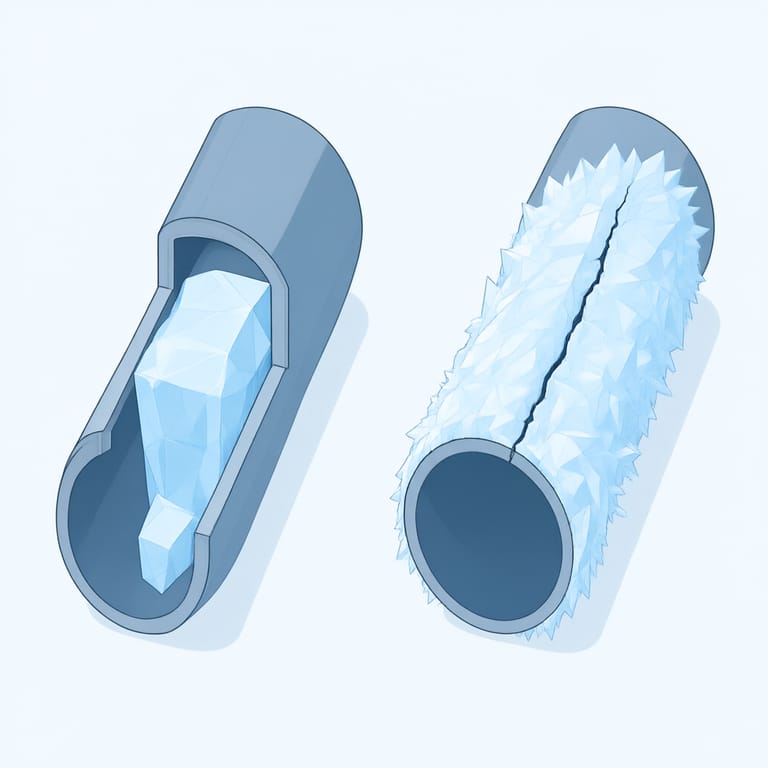
Frozen or Already Burst? Tell Them Apart
The urgent question behind the symptoms: how do you know if your pipes are frozen rather than already split? Awkwardly, ice that broke the pipe often hides the evidence, because the plug seals its own crack until thaw lets water reach the tear.
| Clue | Points to frozen | Points to burst |
|---|---|---|
| Water flow | Weak or none at some fixtures | May return, then stains or drips appear |
| Sound | Gurgle, whistle, banging on use | A single loud pop or bang (a splitting pipe can sound like a gunshot); hissing or running water inside a wall afterward |
| Walls and ceilings | Dry | Damp spots, bubbling paint, sagging drywall |
| Water meter, all faucets closed | Still | Creeping, which means water is going somewhere it shouldn't |
That meter reading is the cleanest test you have: shut every fixture, watch the dial for ten minutes. Movement means a leak, and the job changes from thawing to shutting off the main and calling a pro.
And after the thaw? A split often stays invisible until ice stops sealing it, so the burst check isn't over when water returns. For the next day, re-run the meter test, feel along every joint you warmed, and glance at ceilings and walls below the run. Damp drywall, a musty smell, or a stain that grows overnight means the freeze already did its damage; the line just waited to admit it.
Low Pressure but Not Fully Dead? That's a Warning, Not a Pass
A faucet that still runs, only weaker than usual, is the most useful sign on this page, because you're catching the plug while it's still partial. Ice builds inward from the pipe wall, so pressure fades before flow stops. If pressure at one fixture keeps dropping through a cold evening, treat it as a frozen pipe in progress: open that tap to a steady trickle, warm the room or cabinet it feeds, and check it hourly. Acting during the "weak flow" window is routinely the difference between a warm hair dryer and a plumber's saw.
Need a licensed plumber right now?
Call (800) 555-0173Free call, connects to a licensed local plumberLicensed plumbing partners in your area- Licensed and insured partner network
- 24/7 call routing
- Free call, no obligation
- You approve the price with the plumber directly
How Do I Know If My Pipes Are Frozen? A 5-Minute Walkthrough
- Map the problem. Open every faucet, hot and cold, and note which are dead. One fixture points to its branch line; a cluster on one wall points to a shared run. Only the hot side dead? That's its own pattern; see frozen hot water pipes.
- Follow the dead line through the cold zones. Freezes happen where heat doesn't: crawl spaces, attics, garages, rim joists, cabinets against exterior walls, and around the meter.
- Use your hand. Run it along accessible pipe. An iced-up section is startlingly colder than the same run a foot away. A bitterly cold band on an otherwise cool line is your plug.
- Look before you heat. Check the suspect section for frost, bulges, and hairline cracks. Finding a split before thawing is the difference between a repair and a flood.
How can I tell if my pipes are frozen when none of the plumbing is visible? There are a few more tricks (tapping, temperature mapping, the process of elimination) in how to find where pipes are frozen.
How Cold Does It Have to Get, and How Fast?
Two research-backed numbers put your suspicion on a timeline. The University of Illinois's Building Research Council measured this in the field: uninsulated attic pipes in their tests didn't begin freezing until the outdoor reading dropped to 20°F or below. That is the BRC's "temperature alert threshold," reflecting that unheated spaces hold a few degrees warmer than outside and water in pipes supercools before ice forms. And per Angi's published guidance, unprotected pipes in unheated areas typically freeze in 6-8 hours at 20°F or below, while exposed, poorly insulated runs can start in as little as three.
So: a 25°F night probably didn't freeze your attic run. A night at 15°F, eight hours long? Every symptom above deserves a second look by morning.
What Do Frozen Pipes Look Like?
Often, completely normal. A frozen pipe with dry air around it shows nothing at all, which is why the faucet test outranks the eyeball test. When there are visuals: frost fur or heavy condensation on bare metal, a subtle fattening of copper right at the plug, joints pushed slightly out of line. PEX tolerates expansion better than copper, so it may look pristine with a solid block of ice inside. No bulge doesn't mean no ice.
When a Sign Means "Call Now"
- Any bulge, crack, or damp spot; the line is damaged whether or not it's leaking yet
- A moving meter with everything closed
- The freeze is in a wall, ceiling, or slab you can't open
- Every fixture is dry, or the same line keeps refreezing
A licensed local plumber can locate and thaw the line before pressure finishes the job. Call (800) 555-0173. The line matches you with a licensed, insured pro near you, and the call costs nothing.
Confirmed it's frozen and want to handle it yourself? Go straight to how to thaw frozen pipes: gentle heat, right order, no open flame.