How Much Drip Does It Take to Keep Pipes From Freezing?
Ask a plumber how much drip to keep pipes from freezing and the short answer is a rate, not a number of drops: a steady trickle, not an occasional drop. The American Red Cross guidance on frozen pipes says to let cold water drip from faucets served by exposed pipes, because even a trickle helps prevent freezing: moving water resists ice formation and, just as important, relieves the pressure that actually bursts pipes. A drip every few seconds is better than nothing; a thin, unbroken stream is better still on the coldest nights.
The follow-up question everyone actually cares about: what does running a faucet all night do to the water bill? Less than you'd guess, and we can put honest numbers on it.
How much drip to keep pipes from freezing: the rate table
The U.S. Geological Survey's drip calculator works from a measured assumption: one faucet drip is about 1/4 milliliter, which works out to 15,140 drips per gallon. Applying that USGS figure (the arithmetic below is ours), here's what different rates move in a day:
| Rate | Drops per day | Water used per day |
|---|---|---|
| 10 drops per minute (slow) | 14,400 | About 1 gallon |
| 30 drops per minute (steady) | 43,200 | About 2.9 gallons |
| 1 drop per second | 86,400 | About 5.7 gallons |
| 2 drops per second (near-trickle) | 172,800 | About 11.4 gallons |
| Thin unbroken trickle | n/a | More; measure it with a jug (below) |
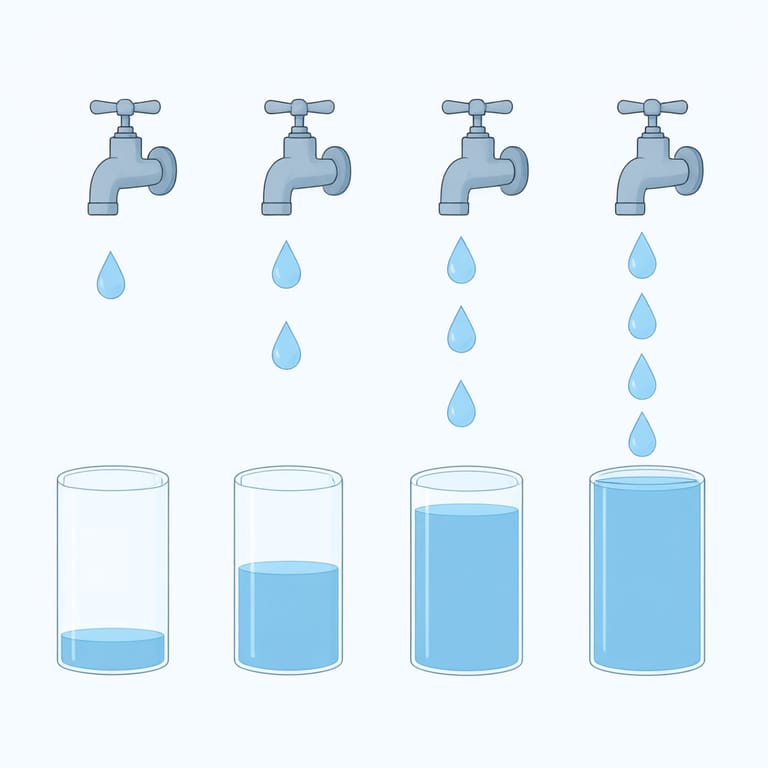
So a faucet releasing one drop per second moves roughly 6 gallons over a full day, closer to 3 through a 12-hour night. Even a cold snap's full week at that rate, running around the clock, is about 40 gallons per faucet: a small line on a utility bill.
What that costs on your bill
We won't quote you a dollar figure, because water rates vary hugely between utilities and many bills charge sewer on the same gallons. The honest method takes two minutes:
- Find the volumetric rate on your water bill, the price per 1,000 gallons or per CCF (748 gallons).
- If your sewer charge is volume-based, add that rate too.
- Multiply by the gallons from the table above for your rate and number of faucets.
For a trickle rather than a drip, skip the table and measure directly: put a one-gallon jug under the faucet, time how long it takes to fill, and scale up to 24 hours. That's your real usage, no estimates.
Well owners pay only the pump's electricity for the extra gallons, which makes the habit even cheaper. But a well system adds its own cold-weather failure points, so pipe insulation matters more there (see our pipe insulation guide).
Drip cost vs. freeze cost: the lopsided math
Whatever your local rate, a few gallons a night is competing against very large numbers on the other side. The Insurance Information Institute reports the average homeowners claim for water damage and freezing at $13,954 (2018-2022 claims), with about 1 in 60 insured homes filing one every year. Even the cheap end of a freeze, a professional thawing call at $100-$200 in 2025 Angi data, costs more than entire winters of a running trickle.
This is the rare home-maintenance decision with no real trade-off. The drip is measured in cents; the downside it prevents is measured in thousands.
Need a licensed plumber right now?
Call (800) 555-0173Free call, connects to a licensed local plumberLicensed plumbing partners in your area- Licensed and insured partner network
- 24/7 call routing
- Free call, no obligation
- You approve the price with the plumber directly
When to start dripping
Two evidence-based thresholds worth knowing, both from our fact research for the freeze belt:
- 28°F for 4-6+ hours. Meteorologists' rule of thumb for exposed or unprotected pipes: freezing risk doesn't start at 32°F, it starts when temperatures hold at 28°F or below for several hours.
- 20°F. The Building Research Council at the University of Illinois found in field tests that uninsulated pipes in unheated spaces begin freezing once outdoor temperatures reach 20°F or below, their "temperature alert threshold." At that point, unprotected pipes can freeze solid in 6-8 hours.
Practical rule for freeze-belt homes: start the drip the evening a forecast shows a low at or below 28°F, and treat 20°F as non-negotiable. Don't shut it off at sunrise if the daytime high stays below freezing, because pipes in unheated spaces track outdoor cold with a lag. More on thermostat settings and thresholds in minimum temperature to prevent frozen pipes.
Which faucets to drip
Knowing how much drip to keep pipes from freezing only pays off at the right taps. Not every faucet, just the ones whose supply pipes cross cold territory:
- Faucets served by pipes in exterior walls, crawl spaces, unheated basements, or garages.
- The faucet farthest from where the main enters the house, which pulls water through the longest run.
- Both handles slightly open on two-handle fixtures, so cold and hot lines both move; single-lever faucets set to the middle.
Pair the open faucet with the rest of the Red Cross prevention playbook: open kitchen and bathroom cabinet doors so room air warms the pipes, keep the thermostat at one temperature day and night, and never set it below 55°F when you're away. Faucet-by-faucet instructions are in our guide on how to drip faucets.
When a drip isn't enough
A drip is pressure relief and motion, not heat. It loses to deep cold in predictable situations:
- Prolonged sub-20°F stretches, where uninsulated pipes freeze despite moving water.
- Power outages that kill the furnace, where the house itself becomes the unheated space.
- Vacant homes, where nobody notices the flow stopped; draining the system beats leaving a tap open there.
- Chronically freezing runs, which need insulation, heat cable, or rerouting. Nursing the same faucet through every winter is a symptom, not a plan.
For those cases, fixes that add or keep heat are the answer. Start with the pipe insulation guide and the full winterization checklist.
If a line has already stopped flowing or you've found a chronic freeze spot you can't reach, that's plumber territory. Call (800) 555-0173 and NorthBriar will connect you with a licensed, insured local plumber. The call is free, and you approve any work directly with the pro.
Quick answers
How much of a drip to keep pipes from freezing?
A drip every few seconds helps, and it's far better than a closed faucet. But on nights at or below 20°F, open the tap to a steady trickle. The cost difference between the two rates is pennies; the protection difference is real.
How much water should drip to keep pipes from freezing overnight?
Work from the table above: at one drop per second, roughly 3 gallons cross a 12-hour night, and a pencil-lead trickle moves somewhat more. On paper that sounds like waste; against the pipes it protects, it's the cheapest water your house uses all winter.
Should I drip hot, cold, or both?
The Red Cross guidance specifies letting cold water drip. On two-handle faucets, cracking both sides slightly protects the hot line too, since hot-water pipes freeze just as readily once they cool.
Can I just drip at night and close it during the day?
Only if daytime temperatures climb above freezing. During an around-the-clock cold snap, keep it running; the few extra gallons are the cheapest part of your winter.
Does dripping guarantee my pipes won't freeze?
No. It sharply lowers the risk and relieves the pressure that causes bursts, but sustained deep cold can still freeze unprotected runs. Treat the open faucet as one layer, with insulation and heat as the others.
Need a licensed plumber right now?
Call (800) 555-0173Free call, connects to a licensed local plumberLicensed plumbing partners in your area- Licensed and insured partner network
- 24/7 call routing
- Free call, no obligation
- You approve the price with the plumber directly