A frozen line just let go? Move in this order
With burst frozen pipes, what you do in the next ten minutes matters more than what already happened, so take the list from the top.
- Shut the main water valve, even if you see no leak yet. Ice can plug a split shut; the flood starts when it melts. The valve is at the point the line enters the house, near the meter or water heater.
- Open the faucets that frozen line feeds. That relieves the pressure trapped in the pipe and gives meltwater a place to exit besides your wall.
- De-energize anything wet. Circuits serving soaked areas go off at the breaker, provided the panel and floor around it are dry. If gas ever reaches your nose, get out of the building at once and call 911 plus the gas utility from the street, touching no switches on the way, breakers included. Nothing else on this list comes before that.
- Never put a flame on the line. No blowtorch, no propane heater, no charcoal anything. That rule comes straight from the American Red Cross and it is absolute.
- Get a pro moving: (800) 555-0173. The call is free, and NorthBriar pairs you with a licensed, insured plumber nearby at any hour of freeze season.
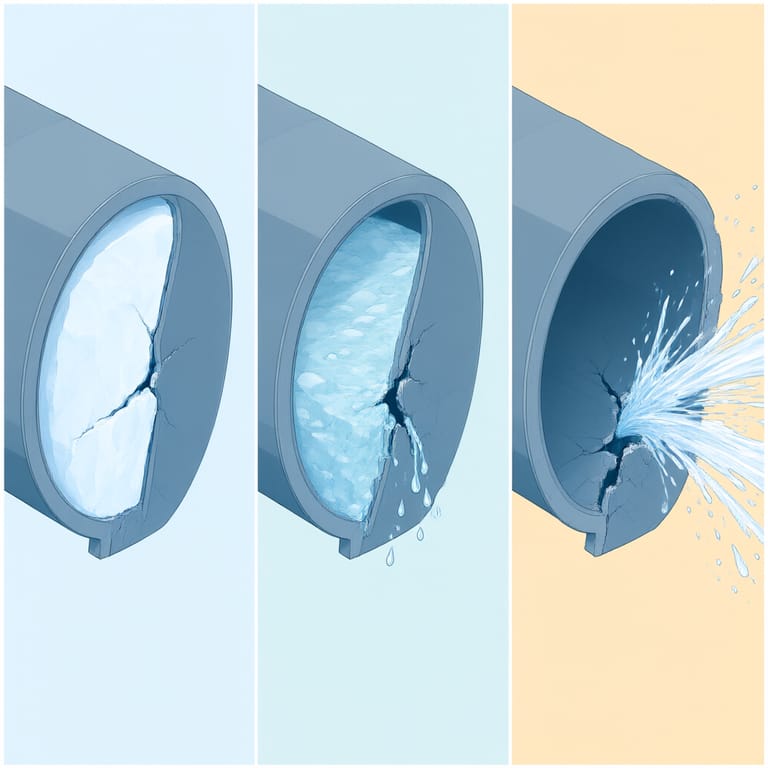
Why burst frozen pipes flood at the thaw, not the freeze
Here's the sequence behind most winter pipe disasters, documented in field research by the Building Research Council at the University of Illinois. First, an ice plug grows until the line is sealed shut. Water trapped between that plug and your closed faucet has nowhere to go, so pressure climbs until the pipe wall splits, often somewhere away from the ice itself. As long as everything stays frozen, the split can sit silent. When the temperature swings up and the plug melts, full line pressure hits the opening, and what looked like a nuisance becomes water pouring into a wall cavity.
That's why "it froze but nothing happened" is a dangerous conclusion, and why step one above is closing the main before the melt.
Do frozen pipes always burst?
No. Plenty of freeze-ups thaw without a drip, and nobody credible publishes a reliable percentage. What's known is directional: risk climbs the longer the line stays frozen, the colder it gets, and the more rigid the material. Copper and CPVC tend to split outright; PEX stretches further before failing, though its fittings can still give. Treat every frozen line as a burst frozen pipe in waiting until water runs clear and pressure holds. The full odds discussion lives at do frozen pipes always burst.
When to worry, and when you can stand down
Worry escalates with these, in order: taps that quit during a hard freeze (an ice plug is already in the line); visible frost, condensation ice, or a bulge on an exposed run; damp drywall or a hiss as the house warms back up, which is how a hidden frozen pipe burst announces itself. Any of those during a thaw deserves the shutdown drill above, because with burst frozen pipes the quiet hours before the melt are exactly when the damage is decided.
You can breathe easier when a thawed line comes back to full, steady pressure with no new stains, sounds, or smells. Check the previously frozen stretch again over the next day as the house finishes warming. Full pressure restored is the Red Cross's own endpoint for a successful thaw; weak flow that never recovers means part of the plug, or a hidden split, is still in there.
Need a licensed plumber right now?
Call (800) 555-0173Free call, connects to a licensed local plumberLicensed plumbing partners in your area- Licensed and insured partner network
- 24/7 call routing
- Free call, no obligation
- You approve the price with the plumber directly
The temperatures that matter up north
Three sourced numbers worth keeping in your head:
- 20°F outside is the freeze-onset threshold the Building Research Council measured for uninsulated runs in unheated attic space, not 32°F.
- 28°F held for roughly 4-6 hours is the broadcast meteorologists' rule of thumb for when exposed, unprotected runs start freezing.
- 6-8 hours at 20°F or below is how long an unprotected line in an unheated area typically takes to freeze solid, per Angi's 2025 guidance.
The usual suspects in freeze-belt houses: runs in exterior walls, attics and crawl spaces, rim-joist penetrations, and garages.
Frozen but not leaking yet? Thaw it safely
If you've caught the freeze before a split, follow the American Red Cross protocol: keep the faucet open while you work (moving water speeds the melt) and apply gentle heat with a hair dryer, an electric heating pad wrapped around the line, hot-water-soaked towels, or a space heater kept well clear of anything flammable. Continue until full pressure returns. Can't find the frozen section, can't reach it, or can't budge it? That's the handoff point to a plumber. Step-by-step help is in frozen pipes: what to do.
The cost math is lopsided
A professional thaw call typically runs $100-200, up to $500 for deep or buried runs, per Angi's 2025 data. The average insurance claim once water damage and freezing enter the picture: $13,954, per the Insurance Information Institute. One of these numbers is a service call; the other is a renovation. Repair pricing for a burst pipe from freezing follows the standard ranges in the burst pipe repair cost guide.
Where this goes next
Water already moving? Go straight to the burst pipe plumber drill, or skip ahead and call (800) 555-0173 now; it's free, and the licensed local pros on the other end handle burst frozen pipes all winter. Everything else burst-related is collected at the burst pipes hub.