Do Frozen Pipes Always Burst? Here Are the Real Odds
Do frozen pipes always burst? No. Pipes freeze in cold-climate houses every winter and most of them thaw without a drop spilled. But "usually fine" is doing a lot of work in that sentence, because whether your frozen pipe bursts comes down to a variable you can't see from outside: pressure trapped in the line. Grasp that mechanism and you hold the difference between a freeze that costs you nothing and one that runs to five figures.
The part almost everyone gets wrong
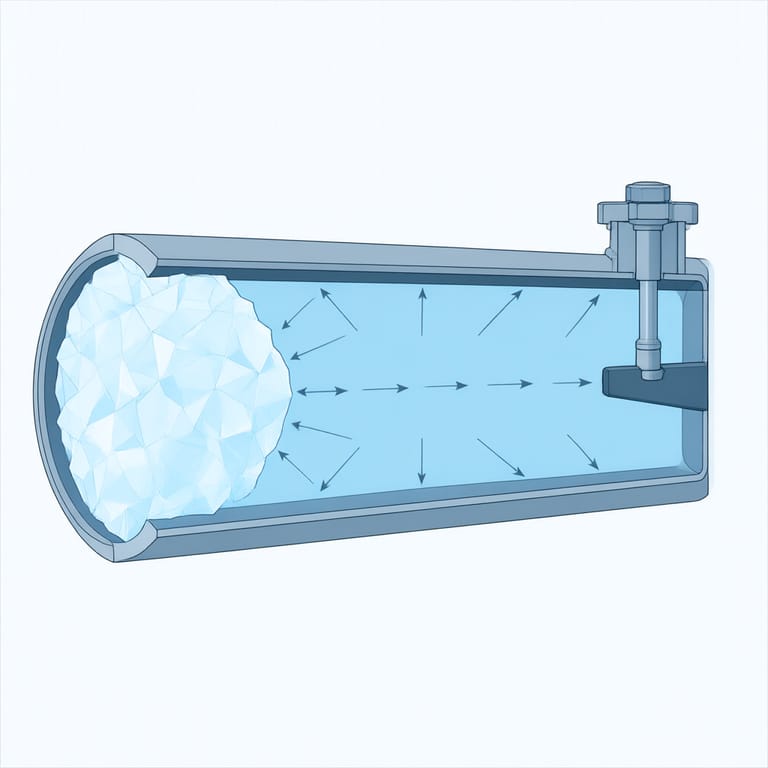
The ice is not what breaks the pipe, and knowing what causes a frozen pipe to burst changes how you handle one. The failure point usually isn't even where the ice is. Field research by the Building Research Council at the University of Illinois, the classic study on residential plumbing failure, found that as an ice plug grows, it seals the line and compresses the water trapped between the ice and the closed faucet downstream. That trapped water can't escape and can't compress, so pressure climbs until something gives. The split usually happens in a section with little or no ice in it at all, sometimes feet away from the blockage.
Two practical consequences follow directly:
- An open faucet is real protection. With the tap open, trapped water has an escape route and pressure can't build. A pipe that freezes with the faucet open is far less likely to burst than the same line sealed at both ends.
- Upstream sections are safer. Between the ice and the water main, pressure stays at normal street pressure, because the system absorbs it. The danger zone is downstream, toward the fixture.
The full failure chain (freeze pressure, water hammer, corrosion, and the rest) is covered in what causes pipes to burst.
So do frozen pipes always burst? What insurers actually count
Here's an honest answer you won't find on most pages: nobody publishes a per-freeze burst percentage, because nobody counts the freezes that end quietly. What insurers do count is the damage. Per the Insurance Information Institute, 2018-2022:
- About 1.61 water-damage-and-freezing claims per 100 insured homes every year, roughly one in sixty homes.
- Average claim severity of $13,954.
- Water damage and freezing produced up to 27.6% of all homeowners insurance losses in a single year (2022, the five-year peak).
Read those numbers as a weather report, not a verdict: most frozen pipes survive, but the ones that don't fail expensively enough to rank second among all causes of home insurance claims.
Does pipe material change the odds?
Yes, meaningfully. Water expands as it freezes, and plumbing materials handle that stress very differently:
| Material | Behavior when frozen | Relative burst risk |
|---|---|---|
| Copper | Rigid; splits lengthwise under ice expansion and pressure | High once fully frozen |
| Galvanized steel | Strong but unyielding; fails at joints and corroded spots | High in older, corroded runs |
| PVC / CPVC | Turns brittle in cold; cracks rather than bulges | High in exposed cold locations |
| PEX | Flexes and swells with ice, usually returns to shape | Lower, but fittings and crimp rings still fail |
| Poly (well/service lines) | Flexible like PEX; tolerates repeated freezes poorly over time | Lower per event, cumulative damage |
Note the fine print on flexible tubing: PEX and poly tolerate a freeze, they don't shrug it off. Expansion stresses fittings, and repeated freeze cycles fatigue the material. "Freeze-resistant" is not "freeze-proof."
Need a licensed plumber right now?
Call (800) 555-0173Free call, connects to a licensed local plumberLicensed plumbing partners in your area- Licensed and insured partner network
- 24/7 call routing
- Free call, no obligation
- You approve the price with the plumber directly
Do pipes burst while frozen, or when they thaw?
The split almost always happens during the freeze, while pressure is at its peak. But you discover it at the thaw, because ice was plugging its own crime scene. Water can't leak past a solid plug, so a ruptured line sits quiet until melting restores flow, and then it leaks at full pressure. That's the trap in waiting out a freeze, and it's why our guide on whether frozen pipes thaw on their own tells you to shut off the main if you can't supervise the thaw.
How long before a frozen pipe bursts?
There's no countdown clock, and anyone giving you an exact number of hours is guessing. Will frozen pipes always burst if they stay that way long enough? Not even then, but risk rises with time frozen, depth of cold, and how much water is trapped under pressure. A run that freezes overnight and thaws by noon often survives; a line that stays frozen through a week-long arctic snap, sealed at both ends, is accumulating stress the entire time. The BRC's freeze-onset threshold (uninsulated pipes in unheated spaces start freezing around 20°F outside) tells you when the clock starts, not when it runs out. Act on the freeze; don't try to outguess the deadline.
Lowering the odds while the pipe is still frozen
Will frozen pipes burst before morning at your house? Nobody can promise either way, but you can shift the probability in your favor tonight, before any thawing starts:
- Open the faucet on the frozen line and leave it open. This is the single highest-leverage move: it gives trapped water an exit and caps the pressure that does the actual bursting.
- Warm the space, not just the line. Thermostat up, cabinet doors open, garage and crawl-space hatches closed against wind. Every degree the cavity gains slows further ice growth.
- Don't shock the line. Rapid, intense heat on one spot of a pressurized frozen line is how DIY thaws end in sprays. Gentle and gradual wins.
- Know your shutoff before you need it. Locate the main valve now, while everything is dry, and clear a path to it.
What to do right now
If the pipe is frozen but not leaking: treat a line frozen but not burst as pressurized anyway. Open the served faucet to vent it, then thaw the line deliberately with gentle heat. The safe step-by-step is in how to thaw frozen pipes. As flow returns, inspect the run and watch for the warning signs in how to tell if a pipe burst: hissing, damp drywall, a spinning water meter with everything off.
If water is already escaping: shut off the main water valve first, because every minute it stays open is gallons into your framing. Kill the breakers for any circuits near the water. Drain the system through the lowest faucet you have. Then call (800) 555-0173: NorthBriar connects you with licensed, insured local plumbers who answer 24/7 during freeze season. And should gas odor ever accompany the leak, get everyone out first and dial 911 from outside; everything else waits.