Most homeowners assume pipes burst at 32°F. Field research says otherwise: the Building Research Council at the University of Illinois measured freezing onset in uninsulated attic pipes when outdoor air fell to 20°F, because water in a pipe supercools several degrees below the textbook freezing point before ice actually forms. That gap between what people expect and what causes pipes to burst in practice is the theme of this page. Here are the eight causes that actually break residential water lines, ranked roughly by how often they do it in the northern U.S.
1. Freezing, the northern heavyweight
Why do pipes burst most in deep cold? The mechanism is sneakier than "ice expands and splits the pipe." An ice plug forms and seals the line; the water trapped between that plug and your closed faucet has no outlet, so pressure climbs relentlessly, and the pipe usually tears somewhere along that pressurized stretch, not at the ice itself. Two more sourced numbers for your mental model: exposed, unprotected runs start freezing around 28°F held for roughly 4-6 hours (the broadcast meteorologists' rule of thumb), and an unprotected line in an unheated space typically freezes solid in 6-8 hours at 20°F or below, per Angi's 2025 guidance. Whether a given freeze actually ends in a split is its own question; see do frozen pipes always burst.
2. Corrosion and plain old age
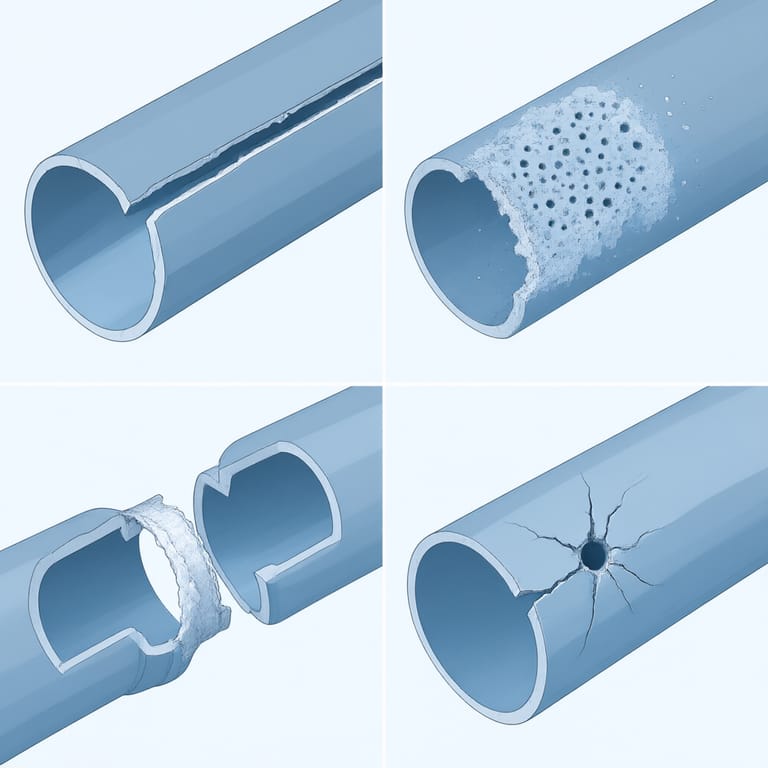
Galvanized steel rusts from the inside out until a wall lets go; copper can develop pinhole leaks where water chemistry eats the metal thin. Corrosion causes failures that announce themselves differently from freeze splits: they start as weeps and pinholes rather than sudden tears, and they cluster on the oldest runs in the house. If your "burst" is the third pinhole on the same line, you have a corrosion problem wearing a burst-pipe costume.
3. Excess water pressure
Supply pressure that's too high stresses every joint, washer, and pipe wall in the system around the clock. Failed pressure regulators and closed systems with no room for thermal expansion (water expands as the water heater warms it) both push lines toward failure. A screw-on gauge at a hose bib is an easy first check. If the reading is high, that's a conversation for a licensed plumber, because the fix involves the regulator or an expansion tank, not a patch.
4. Water hammer
That bang when a washing machine valve or a quick-closing faucet slams shut is a pressure shock wave hitting the end of the line. One bang is noise; years of bangs work joints loose and fatigue pipe walls until one shock finishes the job. Hammer-induced failures typically let go at a joint or fitting, right after a valve closes. The timing is the fingerprint.
5. Clogs that trap pressure
A hard blockage (mineral buildup, debris, or ice acting as a plug) turns part of your supply into a closed vessel. Pressure that would normally dissipate through an open faucet builds against the obstruction instead. This is the same physics as the freeze mechanism, just with a different plug.
Need a licensed plumber right now?
Call (800) 555-0173Free call, connects to a licensed local plumberLicensed plumbing partners in your area- Licensed and insured partner network
- 24/7 call routing
- Free call, no obligation
- You approve the price with the plumber directly
6. Ground movement, frost heave, and roots
Buried lines live in soil that moves. In the freeze belt it moves a lot: design frost depths run 42-60 inches across the upper Midwest and up to 80 inches in northern Minnesota, per state frost-line compilations of FHWA data. Any water line above the local frost line rides seasonal heave cycles that flex and eventually crack it, and tree roots wrap and stress service lines as they grow. A break outside, below grade, with no freeze event inside the house, points here: what causes a water pipe to burst underground is usually movement, not ice.
7. Physical damage
Nail strikes from remodeling projects, an anchor driven into the wrong stud bay, or a line nicked years ago that finally corroded through at the wound. These failures show up where work happened. If the leak appears behind the wall you just hung shelves on, the mystery is not deep.
8. The refill surge: bursts after turning water back on
A pipe that lets go right after a shutoff ends is no coincidence. Reopening the main valve quickly slams pressure into empty, air-filled lines, and the shock finds weak joints, which is why this bites vacant houses and post-repair refills. The fix costs nothing: open the highest faucet in the house first, reopen the main slowly, and let lines fill until water runs steadily before closing everything up.
How does a pipe burst? The break itself testifies
Each culprit signs its work, so match what you found to the cause:
- A long, clean split running along the pipe means freezing; pressure between plug and faucet tears the wall lengthwise.
- Pinholes, green or white crust, rusty weeping mean corrosion.
- A joint or fitting that let go, especially right after banging sounds points to water hammer or pressure.
- A failure below grade outdoors points to frost heave, roots, or ground movement.
- A hole at a screw or nail is physical damage; check the remodel history.
Keep the cut-out section when a plumber makes the repair. Reading it takes them seconds and tells you whether the cause still lives in your system. Suspect a line has already failed somewhere you can't see? Run the checks in signs of a burst pipe.
Stopping what causes pipes to burst, before it starts
- Find and exercise your main shutoff valve now, not during a flood.
- Insulate runs in attics, crawl spaces, and exterior walls, and follow the American Red Cross prevention basics: keep the thermostat steady through cold snaps and never set it below 55°F in an unoccupied house.
- Gauge your water pressure at an outside spigot once a season.
- Secure loose, banging pipes before the noise graduates into a leak.
When the cause is a plumber's problem
DIY ends where diagnosis does. Recurring failures, high gauge readings, hammer you can't trace, or any split inside a wall or below ground calls for licensed hands and proper tools. Call (800) 555-0173: NorthBriar's free line connects you with licensed, insured local plumbers who fix what causes pipes to burst, not just the hole it left. For the repair itself (methods, prices, repair-versus-repipe), see burst pipe repair, and find the full guide family at the burst pipes hub.