Every faucet is off. No laundry running, no one in the shower, the dishwasher is quiet, and the water meter is still creeping. Somewhere in the house, water is leaving the system without your permission. That's the moment most people start searching "how to tell if a pipe burst," and the good news is you can usually settle the question yourself in a few minutes, without opening a single wall.
The meter test: one answer in five minutes
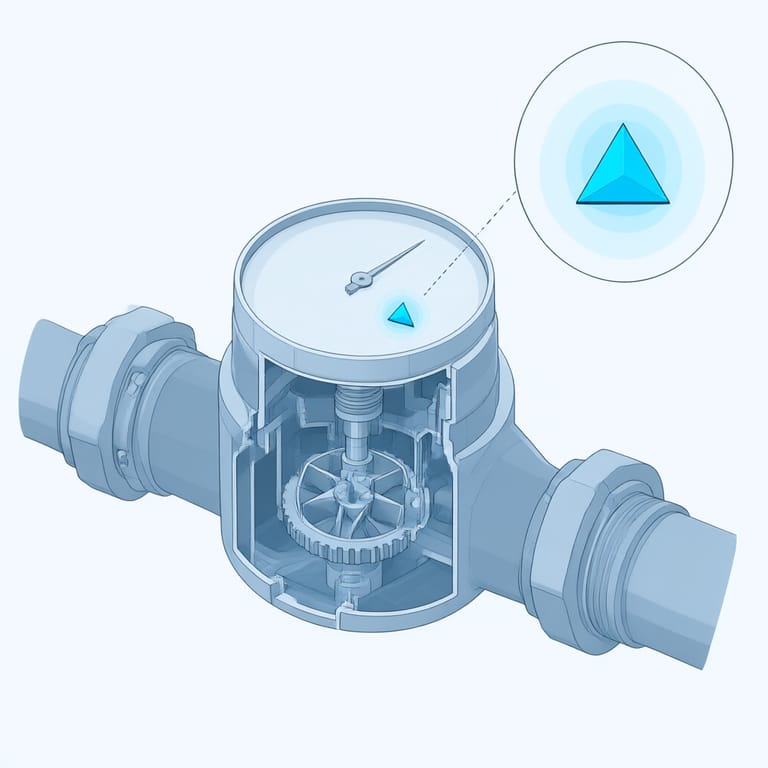
There's a leak detector already installed at your house: the water meter.
- Turn off everything in the home that draws water: every faucet, the ice maker, the humidifier, any irrigation zones.
- Find the meter (basement wall, utility area, or an outside pit near the street) and look for the low-flow indicator: a small triangle, star, or gear that spins with even tiny flow.
- Give it a few minutes of watching. If that indicator creeps at all while every fixture is off, water is leaving the system somewhere.
- Next, close the main shutoff inside the house and check the dial once more. Movement that continues points to the buried run between the meter and your foundation; movement that stops puts the leak indoors.
That one test separates "call a plumber" from "call a plumber about the yard," and it's worth doing before anyone quotes you anything.
Signs of a burst pipe that leave no doubt
- Water where water shouldn't be: pooling on floors, dripping from a ceiling fixture, running down a wall.
- A sagging or bulging ceiling or wall. Drywall holds surprising amounts of water before it lets go. Don't stand under the bulge; don't poke it while you're under it.
- Taps gone dead or sputtering in freezing weather. No water plus a hard freeze often means an ice plug, and possibly a split waiting behind it.
- Pressure that collapses everywhere at once. A single weak faucet is that fixture's problem; when all of them go weak together, suspect the supply itself.
Any of these while water is still flowing: close the main valve first, then work the burst pipe plumber checklist.
The quiet signs, ranked by what they prove
- Hissing or rushing sounds in a wall when nothing is running. Yes, you can often hear a hidden rupture. Pressurized water escaping a supply line makes a steady hiss or whoosh; it's among the most specific clues there is.
- An unexplained jump in the water bill. Put two or three billing cycles side by side; a rise that holds with no change in habits means something is flowing around the clock.
- Paint that bubbles, wallpaper that peels, stains on ceilings or walls: evidence of water, even if older. Fresh stains that keep growing are active leaks.
- Warped, cupped, or soft flooring along one line or in one corner.
- Mold or a musty odor where dampness makes no sense. Mold means moisture has been there a while; the "burst" may be a slower rupture that has been feeding a cavity for weeks.
One caveat a good diagnostician keeps in mind: several of these (a high bill, one damp patch, a faint smell) can also come from a failed fixture seal or a drain problem rather than a pressurized break. The meter test above is what tells you it's supply-side.
What does a burst pipe look like up close?
People picture a pipe blown open like a cartoon. Reality is quieter and worth recognizing on sight:
- A lengthwise split: a straight tear running along the pipe, edges pushed outward. That's the classic freeze failure, where pressure trapped between an ice plug and a closed faucet tears the wall along its weakest seam.
- A pinhole or a cluster of them, often ringed with green, blue, or white crust on copper, meaning corrosion finally ate through. Small hole, big output: a pinhole on a pressurized line can still soak a wall cavity.
- A joint or fitting pulled apart or weeping at the solder line. Pressure spikes and water hammer favor the connections over the pipe itself.
- A bulge or blister in the pipe wall that hasn't opened yet. That one is a courtesy warning; the line is telling you where it plans to fail.
On the pressure question people search (does a burst pipe really spray?): yes, escaping water is under full supply pressure, which is why even a modest opening sprays, hisses, and empties into your framing far faster than a drain leak ever could.
Need a licensed plumber right now?
Call (800) 555-0173Free call, connects to a licensed local plumberLicensed plumbing partners in your area- Licensed and insured partner network
- 24/7 call routing
- Free call, no obligation
- You approve the price with the plumber directly
How to tell if a pipe burst in the wall, under the house, or underground
- Inside a wall: hissing, a warm stripe on drywall (hot line), stains spreading from one point.
- Under the house or in a crawl space: damp smells through floor registers, sagging floor insulation, standing water under the beams.
- Underground in the yard: a persistently soggy patch when nothing else is wet, one strip of grass greener than the rest, soil that has sunk, or the meter test showing flow with the house valve closed. That last check is how to tell if a pipe burst underground without renting a shovel.
- Outside fixtures: a hose bib or irrigation line that froze over winter often splits inside the wall it passes through, so check the interior side of that wall in spring.
Signs a pipe is about to burst
In freeze-belt homes, most ruptures give a warning first. Frost or condensation ice on an exposed pipe, a visible bulge in a line, or taps slowing to a trickle during a cold snap are the pre-failure signals. The physics is unforgiving: Building Research Council field tests at the University of Illinois showed uninsulated pipes in unheated attic space start freezing once outdoor air hits 20°F, and pressure between an ice plug and a closed faucet is what splits the pipe. Catch it at the "no flow" stage and you can often thaw safely before anything tears; the how and why are covered in what causes pipes to burst.
What each outcome costs
Calibrate urgency with real numbers. A professional thaw of a frozen-but-intact line typically runs $100-200 (Angi, 2025). A genuine rupture repair mostly lands between $200 and $3,000, averaging around $500. Ignore the signs long enough for water damage to pile up, and you're in insurance-claim territory: the Insurance Information Institute reports the average water-damage-and-freezing claim at $13,954, with about 1.61 such claims filed per 100 insured homes every year. Full pricing detail: burst pipe repair cost.
Stop checking and call when…
- The meter registers flow with every fixture shut; wherever the leak sits, it's running continuously
- You hear water in a wall and can't find the source
- A ceiling is discoloring or sagging while you watch
- Taps are dead in a freeze and you can't locate or reach the frozen run
- Mold has surfaced, or that musty odor keeps getting stronger
One item on this list is reason enough. Call (800) 555-0173 and NorthBriar connects you free with a licensed, insured local plumber who can pin down what your walls are hiding, with leak-detection gear instead of guesswork.
None of the signs quite fit? The failure modes (freeze, corrosion, pressure, water hammer) each leave different fingerprints; the burst pipes hub will route you to the right next read.