Find Where Pipes Are Frozen: A Faucet-First Method
Start with what still works. Every faucet that runs tells you which pipes are clear; every faucet that doesn't narrows the ice down to one branch. That process of elimination, not crawling around with a flashlight at random, is how to find where pipes are frozen the way plumbers do it, and you can run the first half from inside your house in ten minutes.
Ice waits for no one, and pressure builds behind it the whole time it sits. If you'd rather have a licensed pro find and thaw the line, call (800) 555-0173. NorthBriar connects you with local plumbing partners around the clock in freeze season.
Step 1: Map the dead fixtures
Open every faucet in the house, hot and cold separately, and note what you find:
- One fixture dead, everything else fine. The freeze is in the short branch line serving that fixture, almost always within a few feet of where that line passes through a cold zone.
- Hot side dead, cold side fine. Ice has formed somewhere on the run from the water heater out to that fixture. The pattern is common enough that we cover it separately in frozen hot water pipes.
- Several fixtures on one side of the house dead. The freeze is upstream, in the shared line feeding that group. Picture where those fixtures' lines converge.
- Nothing runs anywhere. The main supply line is frozen, usually where it enters the building or at the meter. If you're not sure your pipes are frozen at all versus a utility outage, run through the signs pipes are frozen first.
Step 2: Trace the line and read the pipe
Follow the run from the dead fixture backward toward the meter, checking every exposed section. You're looking, and feeling, for:
- A section colder than the rest. Run your hand along the pipe. The frozen stretch feels distinctly icy compared to the same line a few feet away.
- A furry white frost coating or beads of condensation sitting on the pipe's surface. Either one is the classic giveaway.
- A slight bulge or deformed spot. Ice expands as it forms; a visible swell means the line has already been stressed and may leak after thawing.
An inexpensive infrared thermometer is the cheapest answer to how to locate frozen pipes without opening anything: sweep it along the run and watch for the temperature to drop sharply. That dip marks your ice.
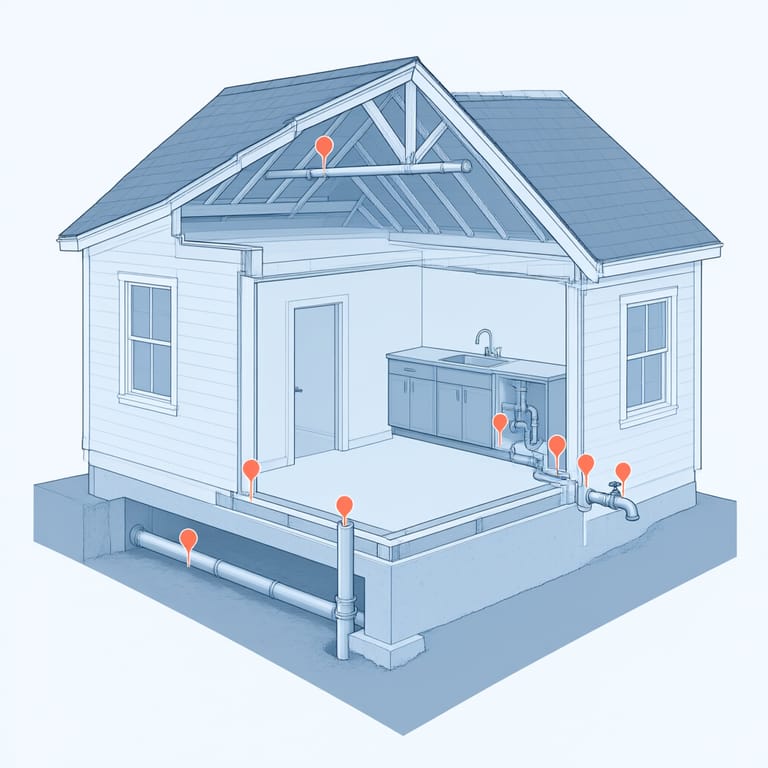
Step 3: Check the usual cold spots first
Freezes cluster in predictable places. Field tests by the Building Research Council at the University of Illinois found that uninsulated pipes in unheated attic spaces begin freezing when the outside temperature falls to 20°F or below, and every one of these zones behaves like that attic:
- Crawl spaces and rim joists, where floor framing meets the foundation
- Sink cabinets on outside walls, kitchen and bathroom both, plus any run strapped to an exterior wall
- Unheated attics, garages, and porches with plumbing overhead or in the wall
- The spot where the service line comes through the foundation
- Outdoor hose bibs and the interior line just behind them
Check these before anything else; that shortlist is how to find frozen pipes fast in most houses, because the majority hide in the first or second zone.
Need a licensed plumber right now?
Call (800) 555-0173Free call, connects to a licensed local plumberLicensed plumbing partners in your area- Licensed and insured partner network
- 24/7 call routing
- Free call, no obligation
- You approve the price with the plumber directly
How to find where pipes are frozen behind drywall or below grade
Finding frozen pipes you can't see is harder but not hopeless. Cold air infiltration leaves clues: a wall section that feels cold to the flat of your hand, a cabinet that's noticeably chillier than the room, an outlet on an exterior wall leaking icy air. An infrared thermometer scanned across the drywall will often show a cold stripe right where the line runs.
Buried water pipes freeze when they run above the frost line, meaning the depth the soil itself freezes down to in winter. That design depth spans 0 to 8 feet across the contiguous U.S. per Federal Highway Administration data, and reaches as much as 80 inches in Minnesota. A water line that was trenched too shallow, or where landscaping removed soil cover, will freeze underground in a hard winter, and that's not a DIY thaw.
When to hand it to a pro
Call a licensed plumber when:
- You've checked every accessible run and cold spot and still can't find the ice; it's likely inside a wall, ceiling, or slab.
- The frozen section is underground or in a space you can't safely enter.
- You found the spot and it's bulged, cracked, or frosted over a long stretch. Thawing that without controlling the pressure risks a flood.
- The main line at the meter is frozen. Municipal-side freezes need the utility or a pro with thawing equipment.
Professional location-plus-thaw service typically runs $100-$200 when nothing has burst, per Angi's 2025-2026 pricing, a fraction of what water damage costs once a hidden split lets go. A frozen-pipe plumber carries pipe-inspection cameras and thermal imaging that find ice in minutes. Call (800) 555-0173 to get connected with one near you.
Found it? Open the faucet before you thaw
Once you've located the freeze, leave the affected faucet open. The American Red Cross thawing protocol starts there, because an open tap relieves the pressure that actually bursts pipes and gives meltwater somewhere to go. Then work through our step-by-step guide to thawing frozen pipes with a hair dryer, heating pad, or space heater, and no open flame, ever.
Need a licensed plumber right now?
Call (800) 555-0173Free call, connects to a licensed local plumberLicensed plumbing partners in your area- Licensed and insured partner network
- 24/7 call routing
- Free call, no obligation
- You approve the price with the plumber directly