Frozen Pipes and No Water: Find the Ice, Get Flow Back
Frozen pipes and no water arrive together on the coldest mornings, and sorting it out comes down to two questions. Is every fixture dry, or just some? And has it actually been cold enough to freeze pipe? Answer those and you know where the ice is, or whether ice is even your problem. And do frozen pipes cause no water at all, house-wide? They genuinely can: a full ice plug seals a line as completely as a closed valve.
Question 1: Whole House Dry, or Just Part of It?
One dead faucet, everything else runs. The freeze is in that fixture's branch line, usually the stretch crossing an unheated space or hugging an exterior wall. Smallest problem, easiest find.
Several dry fixtures, same wall or same floor. They share a supply run; the plug sits upstream of where the group branches apart. Bathrooms stacked over a crawl space are the textbook case.
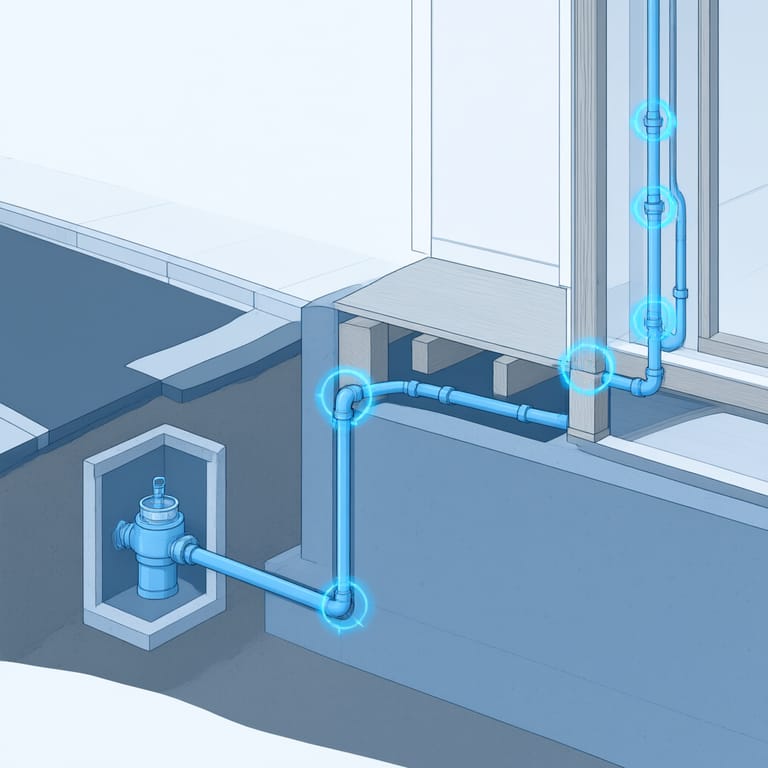
Nothing anywhere, no water in the house at all. Pipes frozen at the trunk explain that: the main service line, the meter, or the first stretch after it enters the building. Check the water meter area first; an uninsulated meter in a shallow pit or cold basement corner freezes before almost anything else.
Only the hot side is dead. Different pattern: the freeze is in the line feeding or leaving your water heater, or the heater itself has an issue. Cold taps working normally is the tell.
Question 2: Was It Freeze Weather?
A quick sanity check before you hunt for ice: hard freezes take real cold, sustained temperatures in the twenties or below, not a chilly 38°F night. If the weather doesn't fit, jump ahead to the "not frozen" section below. If it fits, run the full symptom check in how to know if your pipes are frozen: frost on the line, bulges, odd sounds, a toilet that won't refill.
Frozen Pipes and No Water: Where the Ice Plug Usually Hides
There's a reason total water loss clusters in the coldest states. Water utilities bury service lines below the local frost line, and in the northern tier that's deep: per FHWA frost-depth data compiled by World Population Review, design frost depths run 60-80 inches in northern Minnesota, North Dakota, and Maine, versus 30-50 inches across Illinois, Ohio, and New York. Any pipe above that line (a shallow spot in the yard, the riser into the house, the meter pit) is exposed the moment a deep cold spell settles in.
Inside the house, the usual suspects in order: the meter and its first joints, runs through crawl spaces and rim joists, garage ceilings, attic lines, and supply pipes inside cabinets on exterior walls. Work through them methodically (cold-to-the-touch bands, frost, condensation) or use the elimination method in how to find where pipes are frozen.
Need a licensed plumber right now?
Call (800) 555-0173Free call, connects to a licensed local plumberLicensed plumbing partners in your area- Licensed and insured partner network
- 24/7 call routing
- Free call, no obligation
- You approve the price with the plumber directly
Get Water Moving Again
Once you've found (or strongly suspect) the section:
- Open the dead faucet, and leave it open. This is step one of the American Red Cross's thawing protocol: an open tap relieves pressure, and once melt starts, moving water eats the rest of the plug.
- Apply gentle heat, working from the faucet back toward the ice: hair dryer, wrapped heating pad, hot towels, or a space heater kept clear of anything that burns. The Red Cross bans the rest outright: no blowtorch, no propane or kerosene heater, no open flame of any kind.
- Keep going until pressure is fully back, not just first drips. Step-by-step detail, pipe by pipe: how to thaw frozen pipes.
- Watch every warmed section as flow returns. If a hidden split opens, you want to be standing there: main valve closed, power cut to any wet area, lowest faucet open to drain the system down.
No Water, but the Pipes Aren't Frozen?
When flow dies without freeze weather, or the pipes check out fine, run this list before calling anyone:
- The main shutoff got bumped. Valves near workbenches and storage get closed by accident more often than you'd think. Handle should be parallel to the pipe (ball valve) or fully counterclockwise (gate valve).
- Utility outage or a broken main. Ask a neighbor, or check the utility's outage page. Whole-street dryness is never your plumbing, and if it's the utility's frozen main or meter, their crew handles it.
- Well system trouble. On a well, suspect the pressure switch, a tripped breaker at the pump, or a frozen line between wellhead and house.
- Water heater issues, if only hot taps are dry, and the cold side runs.
When to Stop DIY and Get Help
The freeze wins this round if the plug is in a wall, ceiling, under the slab, or somewhere along a buried service line; if the house has been dry for a day despite your heat; or if thawing revealed damp drywall, stains, or a meter that creeps with every faucet closed. The stakes aren't small: water damage and freezing made up 27.6% of all U.S. homeowners insurance losses in 2022, the worst share in five years, per the Insurance Information Institute.
Not sure whether this is a plumber problem, a utility problem, or an emergency? Who to call for frozen pipes sorts it in sixty seconds. Or skip ahead: (800) 555-0173. NorthBriar connects you with a licensed, insured local plumber, free, around the clock in freeze season.